
British rain rarely arrives the way it does in films. It does not sweep in to a soundtrack; it accumulates. First the air thickens, then the tarmac darkens by degrees, then there is a sound like someone folding paper in the next room, and by the time you look up the whole valley has changed colour. Set that against a year of light, wind and leaf, and you have twelve distinct subjects for a nature journal — not one grey mood repeated, but a calendar of small, specific weathers. The prompts below are meant to be worked month by month, roughly in order. Nobody will mind if you begin in November.
Rain Is Material, Not Interference
It is tempting to treat rain as an obstacle between you and the thing you meant to write about. Turn that around. Rain changes surfaces, so it gives you something to see: bark going almost black, slate shining, fence wire strung with droplets, a path turning from dust to paste in ten minutes. It changes sound, which is a gift to a writer short of adjectives — rain on a shed roof is a dull roar, on hawthorn a hiss, on a car bonnet a tin drum, on a canal almost nothing at all. It changes smell, most sharply after a dry spell. It changes behaviour: snails out, worms on the path, birds sitting tight in the hedge, swallows flying low.
So writing about rain is mostly writing about everything else. The common failure is to describe your feelings about the weather rather than the weather itself. Arm yourself with nouns and get out of the way.
How to Use These Prompts
- Give it ten minutes. Go outside, or stand at an open window. Ten minutes is long enough for the weather to shift and for your first three sentences to be wrong.
- Head the page. Date, time, place. Add the wind direction if you can read it, and say whether the rain is steady, showery, or barely there.
- Write in the present tense in short lines, without stopping to improve anything. Editing comes later, or never.
- Trade mood for measurement. One exact observation is worth two lines of atmosphere. "The rain quickened and the puddle by the gate began to ring" beats a paragraph of melancholy.
- Return in a week with a different pen and add a second note. What did you miss? What has changed, in the place and in your attention?
January, February, March: Cold Rain, Low Light
January — the first rain of the year
Everything is bare, so the rain is unusually audible and visible. Watch how water gathers on twig tips and hangs there before it falls. Prompt: describe one downpour in a hundred words without using the word rain. Name the sound it makes on three different surfaces.
February — rain that cannot decide
Sleet, rain falling onto lying snow, the awkward half-hour when one becomes the other. Sleet ticks; rain patters; the difference is worth catching. Prompt: record the change minute by minute for fifteen minutes, noting what happens to the light on wet road.
March — showers and sunlight
Cumulus showers with bright gaps between them, steam lifting off tarmac, rainbows that vanish while you are still looking. Prompt: write two short passages — one from inside the shower, one from the five minutes after, when the light comes back and everything drips.
April, May, June: Green Light and Wet Blossom
April — petals on tarmac
Rain knocks blossom onto paths and glues it there. Wet petals look nothing like dry ones. Prompt: list five colours and one sound from a single wet walk. Do not use the word grey.
May — rain in the leaves
Once the canopy closes, rain is delayed. You hear it arrive overhead a second or two before it reaches you. Prompt: shelter under a tree through a shower and write what happens above you, then what reaches you, then the smell of wet earth as you walk on.
June — dusk rain
The light lasts until nearly ten. A fine drizzle at dusk is a study in illumination, not wetness. Prompt: sit out a light rain at dusk and describe the light only. No weather words permitted.
July, August, September: Heavy, Warm, Windy
July — the downpour
Convection builds through the afternoon and then the sky lets go. Drops are large, gutters roar, and it is over almost as soon as it began. Prompt: time one downpour from first drop to last. Write the opening two minutes and the closing two minutes as separate pieces.
August — first rain on dry ground
After a dry spell, the first rain is a smell before it is a sound. The ground hisses. Birds bathe in the gutter. Prompt: catch that first rain and describe the scent, then the difference in sound between drops landing on dry soil and on ground already soaked.
September — sideways rain
Equinoctial gales drive rain at an angle, and the angle keeps changing. Leaves come down early and stick to everything. Prompt: from a window, note the direction of the rain every two minutes for twenty minutes, and what it is doing to one particular tree.
October, November, December: Soft Weather and Dark Water
October — mizzle and haar
The Scots have smirr; the west country has mizzle. Rain so fine it never quite falls, yet everything is soaked. Prompt: describe drizzle without using grey, soft or mist. Look for beads on spiders' webs, droplets on fence wire, a wet slate roof.
November — spate
Streams fill fast and run brown with soil and leaves. Drains block. Weirs turn from a trickle into a shout. Prompt: follow a ditch or brook for twenty minutes after heavy rain and list everything it is carrying.
December — rain in the dark
The year's last rain is mostly a matter of reflected light: headlights, shop windows, the orange wash of a street lamp on wet tarmac. Prompt: write two paragraphs about the same rain — one in town, one in a park or field after dark. Keep both to the light.
Keeping the Year Going
Twelve prompts will not write themselves, and the weather will not always oblige. A few small habits make the difference between a good intention and an actual record.
- Keep a pocket notebook and pencil by the door, or in the coat you always wear. Pencil works in the wet; ballpoints give up.
- A rain gauge — or a jam jar with a ruler taped to the side — gives you numbers to set against your sentences. Note the time you read and empty it.
- Choose one place: a street tree, a garden hedge, a footbridge over a stream. Describe it in the same rain in three different months.
- Read January's pages back in December. What you noticed, and how differently you noticed it, is the real record of the year.
- Skip a prompt if it does not fit your week. Twelve is an invitation, not a syllabus.
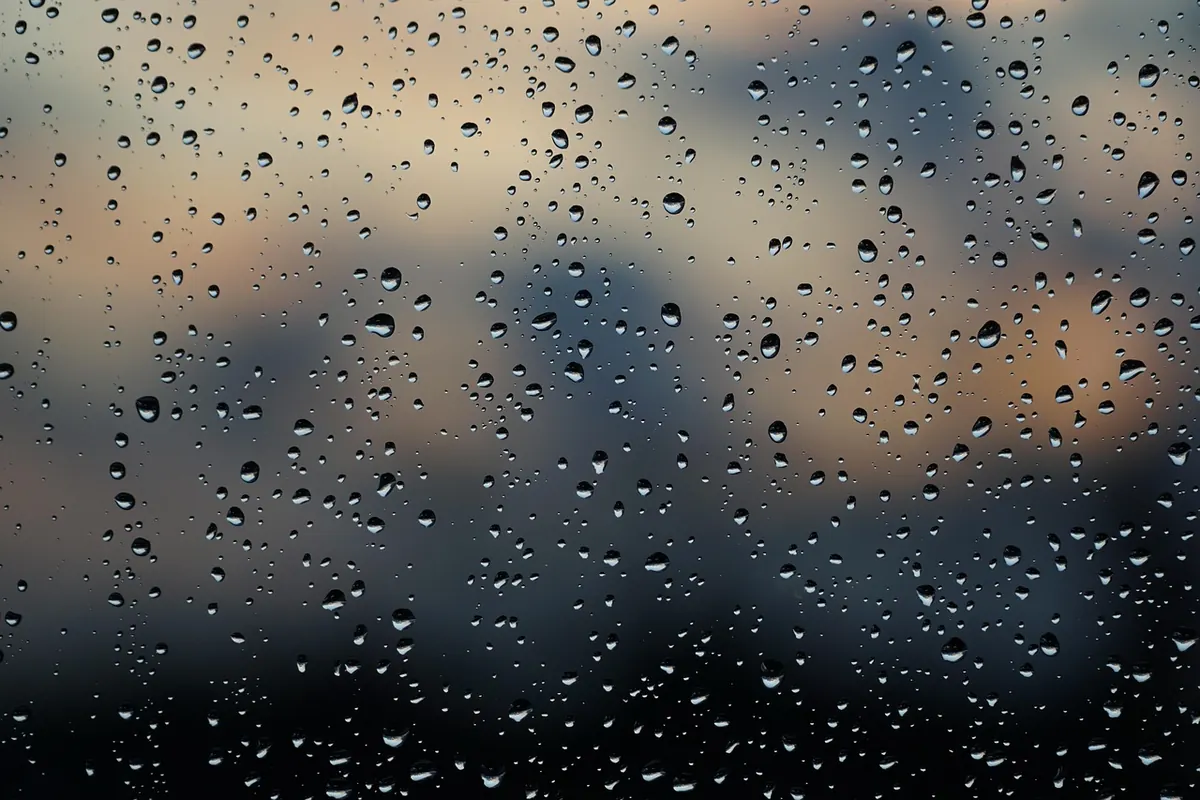
You do not have to get wet. Plenty of good rain writing happens from a kitchen window with the kettle on, watching water run down the glass and the light change over a wet roof. What matters is the ten minutes of attention, the dated page, and the small exact sentence you would not have found if you had stayed at your desk. Start with the next shower.
Photo: Kranich17 / Pixabay